An Insider's Guide to WAICY (Part 2): Choosing the Right Track for Your Skills
- jophy2467
- Oct 25, 2025
- 8 min read

The first decision you'll make in WAICY isn't what to build; it's which track to compete in.
This choice is more strategic than you might think. Pick the wrong track for your skill set, and you'll either be in over your head or underselling your abilities. Pick the right one, and you maximize your chances of standing out.
When I competed in 2023, I entered two tracks: AI Showcase (where I became a finalist) and AI-Generated Art (where I placed 4th). Looking back, I made the right call on Showcase, as it played to my strengths in coding and technical implementation. But I also learned valuable lessons about track selection that I wish I'd known earlier.
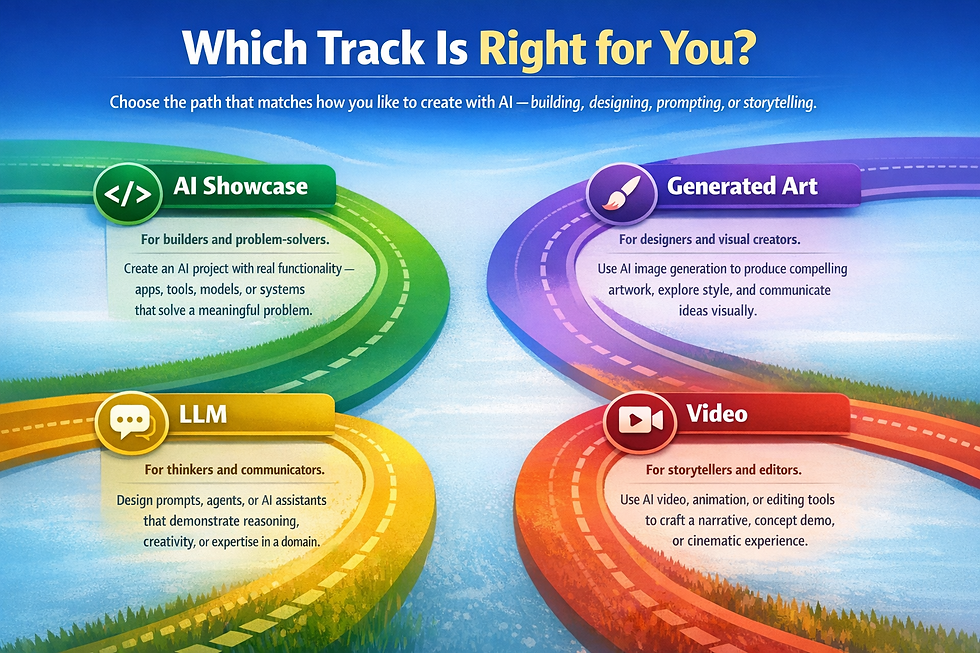
This post breaks down all four WAICY tracks, what each one actually requires, and how to strategically choose where to compete.

Summary
This article provides an in-depth breakdown of WAICY's four competition tracks: AI Showcase, AI-Generated Art, AI Large Language Models, and AI-Generated Video. I explain what each track requires (technical skills, time commitment, project scope), who each track is best suited for, and the strategic considerations for choosing where to compete. Drawing from my experience competing in AI Showcase (finalist) and AI-Generated Art (4th place), I share decision-making frameworks including the technical capability vs. time available matrix, how to assess your competitive advantage in each track, and why entering multiple tracks can be a smart strategy. I also address common mistakes like choosing tracks based on perceived prestige rather than fit, and provide specific guidance on skill prerequisites for each track.
The Four Tracks Explained
WAICY currently offers four competition tracks. In 2023, when I competed, only three existed (Showcase, Art, and LLM). The Video track was added in later years, but I'll cover all four here.
Each track has different requirements, skill demands, and competitive dynamics.
Track 1: AI Showcase
What it is: Build an AI-powered project that solves a real-world problem.
What you submit:
Working AI application/system
3-minute presentation video
3-minute demo video
Written documentation of your project
Q&A session with judges (if you make finals)
Technical requirements:
You need to actually implement AI (not just talk about it theoretically)
Common approaches: computer vision (YOLO, CNNs), natural language processing (GPT APIs, transformers), machine learning models (classification, regression), recommendation systems, or robotics with AI components
Skill level: High
This is the most technically demanding track. You need to:
Code (Python is most common)
Understand AI/ML concepts well enough to implement them
Debug when things inevitably break
Integrate multiple technologies (APIs, databases, frameworks)
Time commitment: High (2-6 weeks depending on project complexity)
What judges look for:
Originality - Is your solution novel?
Social relevance - Does it solve a meaningful real-world problem?
AI complexity - How sophisticated is your AI implementation?
Ethical thinking - Have you considered potential harms, biases, or misuse?
Technical execution - Does it actually work?
Competitive landscape:
This is the most prestigious and competitive track
High schoolers who make finals in Showcase are rare
But if you pull it off, it's incredibly impressive
My experience:
I competed in AI Showcase with NutriGuide, an app that used YOLO for food detection and OpenAI's API for nutritional guidance. It took me 2-3 weeks working solo to build, working several hours daily.
What worked: I picked a problem I genuinely cared about (nutrition and sustainability), which made the research and development more engaging. The project combined multiple AI technologies (computer vision + NLP), which demonstrated breadth.
What was hard: Debugging the YOLO model integration. Getting the Flask server to communicate properly with the mobile app. Making sure everything actually worked in the demo.
Who should choose this track:
You're comfortable coding (or willing to learn fast)
You want the most technically impressive credential
You have a specific problem you're passionate about solving
You have 3+ weeks to dedicate to building and testing
Who should skip it:
You're brand new to coding
You have less than 2 weeks available
You prefer creative/artistic work over technical implementation
You want a lower-stress competition experience
Track 2: AI-Generated Art
What it is: Use text-to-image AI models to create artwork based on an annual theme.
What you submit:
Your AI-generated artwork(s)
Explanation of your prompt engineering process
Artist statement about your concept
Documentation of which AI tools you used
Technical requirements:
Access to AI image generation tools (DALL-E, Midjourney, Stable Diffusion, etc.)
Understanding of prompt engineering
Artistic vision and concept development
Skill level: Low to Medium
You don't need to code. You don't need to train models. You need:
Creativity and artistic sensibility
Prompt engineering skills (knowing how to get AI to generate what you want)
Iteration and refinement (trying many prompts until you get something compelling)
Time commitment: Low to Medium (a few days to 2 weeks)
Theme changes annually. In 2023, the theme was "Joys of Family." In other years it's been "Future of Technology," "Climate Change," etc.
What judges look for:
Creativity and originality - Is your artistic vision unique?
Thematic relevance - How well does your art explore the annual theme?
Technical skill - How sophisticated is your prompt engineering?
Artistic merit - Is it actually good art?
Competitive landscape:
Less technically demanding than Showcase
Still competitive, but more accessible
Mix of students from all levels (elementary through high school)
Strong artistic vision matters more than coding ability
My experience:
I submitted "Joys of Family" using AI image generation and placed 4th in this track.
What worked: I spent time thinking conceptually about what "family" meant before jumping into prompts. I iterated a lot—probably 50+ generations before settling on final pieces.
What I'd do differently: I treated this track as secondary to Showcase and didn't give it as much attention. If I'd spent more time refining the artistic concept and prompt engineering, I might have placed higher.
Who should choose this track:
You're more artistic than technical
You want to explore AI creatively without coding
You have a strong conceptual/visual sense
You're good at iterating and refining ideas
You want a lower barrier to entry
Who should skip it:
You have zero interest in visual art
You prefer building functional tools over creating aesthetic work
You want the most technically impressive credential (Showcase is better for that)
Track 3: AI Large Language Models
What it is: Use LLMs (like ChatGPT, Claude, Bard) to demonstrate AI capabilities in a specific domain or solve a specific problem.
What you submit:
Documentation of your LLM application/use case
Examples of prompts and outputs
Explanation of your approach and methodology
Evidence of the LLM's effectiveness in your chosen domain
Technical requirements:
Access to LLM APIs or interfaces
Strong prompt engineering skills
Understanding of a specific domain where you're applying the LLM
Critical thinking about AI capabilities and limitations
Skill level: Low to Medium
Like the Art track, you don't need to code (though API integration helps). You need:
Excellent prompt engineering
Domain knowledge (e.g., if you're building an LLM for medical advice, you need to understand medical concepts)
Critical analysis of AI outputs
Creativity in application
Time commitment: Low to Medium (a few days to 2 weeks)
What judges look for:
Novel application - Are you using LLMs in an interesting, unexpected way?
Prompt sophistication - How advanced is your prompt engineering?
Domain relevance - How well does your LLM perform in the chosen domain?
Critical awareness - Do you understand the limitations and risks?
Competitive landscape:
Accessible to beginners
Can be sophisticated if you go deep into prompt engineering
Less competitive than Showcase but still requires strong execution
My take:
I didn't compete in this track, but here's what I observed:
Winning projects often:
Picked niche domains where LLMs could add real value (education for dyslexic students, mental health chatbots, language learning tools)
Demonstrated sophisticated prompt engineering (not just basic ChatGPT queries)
Showed clear evidence of testing and iteration
Addressed ethical considerations (bias, safety, misinformation)
Who should choose this track:
You're interested in how LLMs can solve specific problems
You have domain expertise you want to apply (education, healthcare, accessibility, etc.)
You're strong at writing and communication
You want to explore AI without heavy technical implementation
Who should skip it:
You want to build something more hands-on
You don't enjoy iterative prompt testing
You prefer visual/artistic work (do Art track instead)
Track 4: AI-Generated Video
What it is: Use AI tools to create a short video that addresses a real-world problem or conveys a compelling message.
What you submit:
Your AI-generated video (typically 1-3 minutes)
Explanation of AI tools used
Concept and creative vision statement
Technical process documentation
Technical requirements:
Access to AI video generation tools (RunwayML, Synthesia, etc.) or AI tools for video editing/enhancement
Video editing skills
Storytelling ability
Creative vision
Skill level: Medium
More complex than static art, less technical than building a working AI system. You need:
Familiarity with video creation/editing
Understanding of AI video tools
Strong storytelling and narrative skills
Ability to integrate multiple AI technologies (video gen, voice, music, effects)
Time commitment: Medium (1-3 weeks)
What judges look for:
Creative use of AI - How innovatively are you using AI video tools?
Message/impact - Does your video convey something meaningful?
Production quality - Is it well-executed?
Technical sophistication - How advanced is your use of AI tools?
Competitive landscape:
Newer track (added after 2023)
Still establishing competitive norms
Opportunity to stand out in a less saturated track
My take:
This track sits in an interesting middle ground:
More creative than Showcase
More technically involved than Art or LLM
Requires different skills (video production + AI)
Who should choose this track:
You have video editing experience
You're interested in AI-generated media
You have a compelling story/message to tell
You want to combine creative and technical skills
Who should skip it:
You have no video production experience
You prefer static visual art (do Art track)
You prefer coding projects (do Showcase)
Strategic Track Selection Framework
Here's how to actually decide:
Step 1: Assess Your Skills Honestly
Technical coding ability:
Strong (can code independently): Showcase is viable
Moderate (can code with help): Showcase possible but challenging
Beginner/None: Art, LLM, or Video tracks
Artistic/creative ability:
Strong visual sense: Art or Video
Strong writing/communication: LLM
Both: Any track works
Domain expertise:
Have specific knowledge (healthcare, education, etc.): Showcase or LLM
General knowledge: Any track
Step 2: Consider Time Available
Less than 1 week: Art or LLM only
1-2 weeks: Art, LLM, or Video
2-4 weeks: Any track, Showcase realistic
4+ weeks: Showcase with complex project possible
Step 3: Define Your Goal
Maximum prestige/impressiveness: AI Showcase
Want to actually learn AI deeply: AI Showcase
Want accessible entry point: AI-Generated Art or LLM
Want creative expression: AI-Generated Art or Video
Want to explore specific domain: LLM or Showcase
Step 4: Evaluate Competitive Advantage
Ask yourself: In which track am I most likely to stand out?
If you're a strong coder but average artist: Showcase
If you're artistic but can't code: Art or Video
If you have deep knowledge in a niche area: LLM or Showcase
If you're new to AI but willing to work hard: Any track, but start with Art or LLM
The Multi-Track Strategy
Here's something most people don't consider: You can enter multiple tracks. I entered two (Showcase and Art), and it was the right call. Here's why:
Advantages:
1. Hedge your bets
If one project doesn't pan out, you have a backup
Increases your chances of placing
2. Showcase different skills
I demonstrated both technical ability (Showcase) and creative thinking (Art)
Makes your overall WAICY achievement more well-rounded
3. Learn more
Working across tracks exposed me to different AI tools and approaches
Disadvantages:
1. Time commitment
Building for two tracks means less depth in each
Risk spreading yourself too thin
2. Focus dilution
Might be better to go deep in one track than surface-level in two
My recommendation:
Enter multiple tracks if:
You have 3+ weeks available
You have complementary skills (e.g., coding + art)
One track is clearly your main focus and the other is secondary
Stick to one track if:
You have less than 2 weeks
You want to maximize depth over breadth
Your skills clearly fit one track best
What's Next
In Part 3, I'll dive into strategies to actually stand out: how to pick a problem worth solving, what makes judges say "wow" versus "meh," technical execution tips specific to each track, presentation strategies for finals, and the mistakes that sink otherwise strong projects. This is where we get tactical—everything I learned about turning a good idea into a finalist-worthy project.
About the Author: I'm Jophy Lin, a high school senior and researcher. I blog about a variety of topics, such as STEM research, competitions, shows, and my experiences in the scientific community. If you’re interested in research tips, competition insights, drama reviews, personal reflections on STEM opportunities, and other related topics, subscribe to my newsletter to stay updated!


Comments