An Insider's Guide to WAICY (Part 4): Lessons Learned
- jophy2467
- Nov 5, 2025
- 8 min read

Six months after WAICY 2023 finals, someone asked me: "Was it worth it?"
I didn't have an immediate answer.
On paper, yes. I became a finalist in one of the world's largest AI competitions, placed 4th in another track, and added a legitimate achievement to my college applications. But the real value of WAICY wasn't the credential—it was everything I learned about working under pressure, navigating ambiguity, and what actually matters when you're trying to do something difficult.
This final part isn't about strategy or tactics. It's about the bigger lessons: what this experience taught me beyond AI, whether I'd recommend WAICY to others, and what I wish I'd known before starting.


Summary
This article reflects on the meta-lessons from competing in WAICY and insights that extend beyond the competition itself. I share what I learned about time management under pressure, dealing with uncertainty and setbacks, and the difference between external validation and internal growth. I provide honest reflections on whether WAICY was worth the effort, advice I'd give my past self, and specific guidance for three types of students considering WAICY: beginners, experienced competitors, and those on the fence. I close with thoughts on what "success" in competitions actually means and why the process often matters more than the outcome.
The Lessons Nobody Tells You About
Lesson 1: Compressed Timelines Force Clarity
I had 2-3 weeks to build NutriGuide from scratch. That constraint was the best thing that could have happened to me.
Why? Because it forced me to ask: What actually matters?
I couldn't afford to waste time on features that sounded cool but didn't advance the core functionality. I couldn't get lost in perfectionism. I had to ruthlessly prioritize.
This translated to everything else in my life. When I'm working on research papers, college essays, or any project now, I ask: "If I only had three weeks, what would I focus on?"
That question cuts through so much noise.
The meta-skill: Learning to operate effectively under tight constraints is more valuable than any specific technical skill. Most real-world problems have deadlines. WAICY taught me how to work backward from a deadline and make smart tradeoffs.
Lesson 2: You Learn More from Things That Don't Work
My first WAICY project idea was a disaster.
I wanted to build an AI system that could predict mental health crises by analyzing social media posts. It was ambitious, technically complex, and... completely unrealistic for a 2-3 week timeline. Also, deeply ethically problematic in ways I didn't initially appreciate.
I spent three days on it before realizing: This isn't going to work.
Pivoting to NutriGuide felt like failure at the time. Looking back, that pivot was the smartest decision I made.
What I learned:
Recognizing when something isn't working is a skill
Cutting your losses early is better than stubbornly pursuing a bad idea
Constraints breed creativity—NutriGuide was born from "what CAN I build in two weeks?"
The meta-skill: Knowing when to quit and when to persist is one of the hardest judgments you'll make. WAICY gave me practice in a relatively low-stakes environment.
Lesson 3: Your Relationship with Failure Changes
I submitted to WAICY expecting to fail.
Not because I thought my project was bad, but because 17,000+ competitors and fewer than 40 finalists meant failure was statistically likely.
When I made finals, I was thrilled. But I was also prepared for the possibility of not making it. That mental preparation of acknowledging that failure was likely and would be okay made the entire experience less stressful.
The shift: I stopped viewing competitions as binary win/lose and started seeing them as experiments with unknown outcomes.
Did I learn something? Yes. Did I build something real? Yes. Did I push my skills? Yes.
Those things were true regardless of whether I placed.
The meta-skill: Detaching your self-worth from outcomes while still caring about the work is paradoxically what makes you perform better.
What I Wish I'd Known Before Starting
The Judging Criteria Aren't What You Think
I spent so much time making my AI technically sophisticated.
But judges cared equally about:
Can you articulate why this problem matters?
Have you thought about who this could harm?
Do you understand the limitations of your approach?
If I could redo it, I'd spend less time tweaking the YOLO model and more time researching the nutritional education landscape, understanding my users, and thinking through edge cases.
Takeaway: Technical execution is table stakes. The differentiator is thoughtfulness about context, impact, and ethics.
I Wish I'd Known: Virtual Presenting Is a Different Skill
I practiced my presentation in person, looking at my laptop screen.
During finals, I was looking at a camera while judges were in a Zoom grid. It felt totally different—like performing to a void.
If I could redo: Practice presenting to a camera, not a person. Record yourself. Get comfortable with the awkwardness of talking to a lens.
You Don't Need to Have Everything Figured Out
I stressed about whether my project was "good enough" before submitting.
Here's the truth: Nobody has everything figured out. Every finalist had aspects of their project they wished were better. Every winner had features they didn't have time to implement.
Submit your best effort by the deadline. That's all anyone can do.
Was It Worth It? (Honest Reflection)
For College Applications: Yes
Being a WAICY finalist is a concrete, verifiable achievement. It's internationally recognized. It demonstrated technical ability, initiative, and follow-through.
Will it get me into college? I don't know—admissions is a black box. But it was a strong data point.
For Learning AI: Absolutely Yes
I learned more about practical AI implementation in three weeks than in months of online courses.
Why? Because I had to make it work. I couldn't just watch tutorials and nod along. I had to debug, iterate, and problem-solve in real-time.
Courses teach you what's possible. Projects teach you how to make it happen.
For Skill Development: Yes
Beyond AI, I developed:
Project scoping and time management
Technical writing and documentation
Presentation and communication
Dealing with ambiguity and setbacks
These are skills that transfer to literally everything else.
For the Credential Itself: Sort Of
If the only reason you're doing WAICY is for the resume line, you'll burn out. The credential is nice. But the real value is the competence you develop along the way.
For Personal Growth: Unexpectedly Yes
I learned I could build something real under pressure. I learned I could handle technical failures without spiraling. I learned I could present confidently to judges across the world.
Bottom line: Worth it, but not primarily for the reasons I thought going in.
Advice I'd Give My Past Self
1. Start earlier than you think you need to
I gave myself exactly the minimum time needed. If anything had gone wrong (and things did go wrong), I would've been screwed.
Buffer time is your friend.
2. Pick the problem first, the technology second
I got too excited about using YOLO and worked backward to find a problem it could solve.
Better approach: Find a problem you care about, then figure out which AI approach fits.
3. Talk to potential users early
I built NutriGuide based on assumptions about what people wanted in a nutrition app. I should've talked to 5-10 people first and validated those assumptions.
4. Enjoy the process more
I was so focused on making finals that I didn't fully appreciate the experience of building something cool and meeting talented people from around the world.
The competition lasts a few weeks. The memories and skills last much longer.
Advice for Different Types of Students
If You're a Beginner
Do it anyway.
WAICY is more accessible than you think. You don't need to be a coding prodigy. You need curiosity and willingness to learn.
Start with:
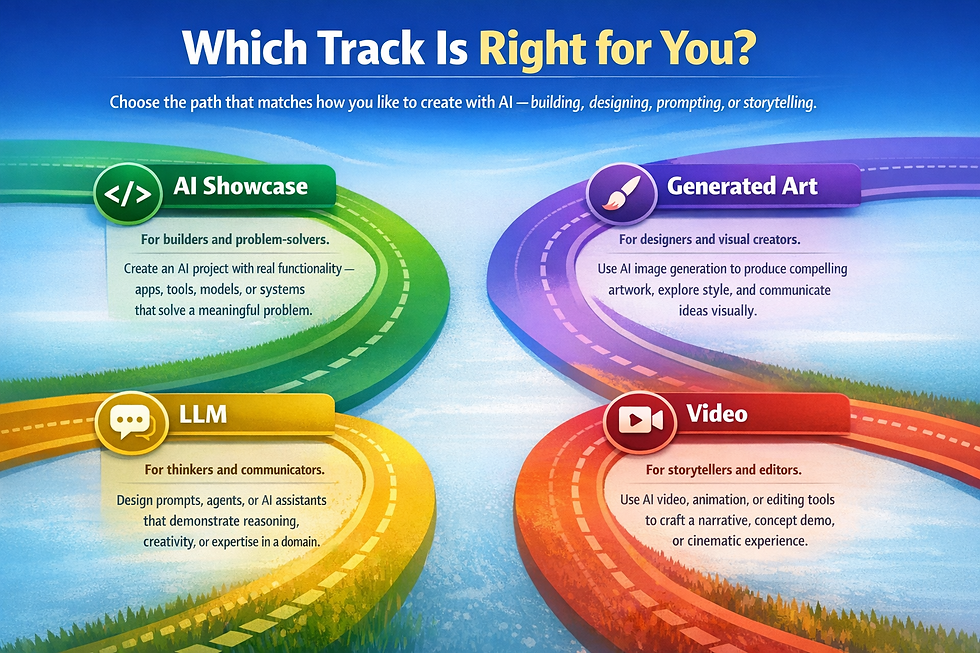
AI-Generated Art or LLM track (lower technical barriers)
Simple, focused project (don't try to build the next Google)
Lots of Googling and learning as you go
Expect:
Frustration (you'll get stuck a lot)
Imposter syndrome (everyone else will seem smarter)
Growth (you'll learn an insane amount)
Don't expect:
To make finals your first time (possible but unlikely)
To know everything before you start
It to be easy
Mindset: Treat it as a learning experience, not a credential hunt.
If You're an Experienced Competitor
Push yourself.
Don't coast on skills you already have. Use WAICY to learn something new.
Consider:
AI Showcase track with a technically ambitious project
Entering multiple tracks to challenge different skill sets
Mentoring other competitors (you'll learn by teaching)
Avoid:
Building something you already know how to build
Treating it as just another competition box to check
Forgetting to actually enjoy the process
Mindset: Use WAICY as an opportunity to expand your capabilities, not just validate existing ones.
If You're On the Fence
Ask yourself:
1. Do you have 2-4 weeks to dedicate?
If no, wait until you do. Rushed projects rarely turn out well.
2. Are you genuinely curious about AI?
If yes, WAICY is one of the best ways to get hands-on experience.
If no, there are better uses of your time.
3. What's holding you back?
"I'm not good enough" → Nobody starts out good. You learn by doing.
"I don't have time" → Fair. Wait for a less busy period.
"I won't make finals" → Probably true (statistically), but you'll still learn a lot.
"I don't know where to start" → That's what Parts 1-3 of this series are for.
Decision framework:
If the idea of building something with AI excites you, do it. If you're only doing it for college apps and the thought fills you with dread, skip it.
Life is too short for competitions you hate.
What "Success" Actually Means
I made finals. I placed 4th in another track. By conventional measures, I "succeeded" at WAICY.
But some of my friends who didn't make finals also "succeeded" by different measures:
One built their first-ever AI project and discovered they love ML
One learned Python from scratch during the competition
One didn't place but got so much better at presenting technical work
One made friends with other competitors and now collaborates on research
The lesson: Success isn't just the prize. It's what you learned, who you became, and what doors opened because you tried.
I learned more from the three days I spent on my failed first project idea than from some competitions I've won. Failure taught me to pivot faster. That's valuable.
Redefining success:
Did you learn something new? → Success
Did you build something real? → Success
Did you push beyond your comfort zone? → Success
Did you connect with others who share your interests? → Success
Placing is great. But it's not the only measure that matters.
Final Thoughts: Why Compete at All?
Here's what I've realized about competitions in general: They're not about winning.
They're about:
Forcing yourself to actually build/create/do something
Getting feedback from people who know what they're talking about
Connecting with others who care about the same things you do
Proving to yourself that you can do hard things
WAICY gave me all of that.
Did I need to make finals to get value from it? No. Did making finals validate that I could compete at a high level? Yes, and that felt good.
But the deeper value was the competence and confidence I built along the way.
If you're reading this series wondering whether to compete:
Do it if:
The idea of building an AI project sounds fun (even if scary)
You want to learn by doing, not just by reading
You're okay with the possibility of not placing
You have time to commit without sacrificing your mental health
Don't do it if:
You're only chasing credentials and would hate the actual work
You're already overwhelmed and this would push you over the edge
You have no interest in AI whatsoever
My final piece of advice:
Competitions are tools. Use them when they serve your goals. Don't do them just because other people are.
But if you're genuinely curious about AI and want to build something real, WAICY is one of the best opportunities available to high school students.
Take the leap. You'll learn more than you expect.
About the Author: I'm Jophy Lin, a high school senior and researcher. I blog about a variety of topics, such as STEM research, competitions, shows, and my experiences in the scientific community. If you’re interested in research tips, competition insights, drama reviews, personal reflections on STEM opportunities, and other related topics, subscribe to my newsletter to stay updated!


Comments